Meniscus Tears: How can physical therapy help you avoid knee surgery?
Summary:
In many cases, surgery for meniscus tears can be avoided with the right exercise-based rehab program. In this article, I will discuss the benefits of physical therapy for meniscus tears plus 3 categories of physical therapy exercises that can help you avoid knee surgery.
Is your knee hurting right now?
Nearly everyone experiences knee pain at some point in their life; however, their pain usually goes away after a few days or weeks.
If their pain does not go away, they realize there may be a bigger issue and decide to call their doctor. In most cases, their doctor will refer them to a physical therapist for an exercise-based rehab program prior to an MRI.
Persistent knee pain may your issue right now. Perhaps, you tripped and twisted your knee. You may have injured your knee while playing sports like soccer.
I understand you may be concerned about having a meniscus tear. Before we get started with understanding meniscus tears, I want you to know two things:
1) Meniscus tears are difficult to diagnose without an assessment.
2) A meniscus tear on your MRI does not mean you need surgery right away.
By the end of this article, you should feel more confident to recover from your nagging knee pain.
What is the meniscus?
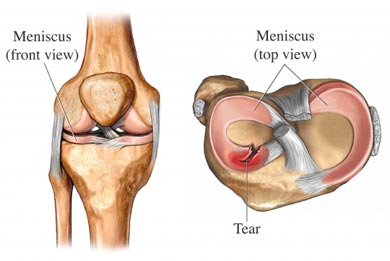
The meniscus is an extra layer of cartilage the provides cushion and support to the knee joint. There is an inner and outer meniscus on the surface of the cartilage in the knee.
The cartilage and meniscus function as a shock absorber for the knee by distributing pressure in the knee joint. Unfortunately, meniscus tears are one of the most common injuries of the knee.
Meniscus Anatomy
- The image on the right shows the meniscus on each side of the knee joint.
- The meniscus on the inner portion of the knee is called the medial meniscus.
- The meniscus on the outer portion of the knee is called the lateral meniscus.

What are common symptoms of a torn meniscus?
- Popping, clicking, and locking of the knee
- Tenderness to the joint line of the knee
- Sharp, stabbing pain in the knee
- Pain with twisting or bearing weight on the knee
- Limitations with bending or straightening the knee

What causes a meniscus tear?
Meniscus tears can occur while twisting aggressively on a bent knee. Soccer players are at risk of knee injuries due to the unpredictable nature of their sport.
Here are a few potential causes of meniscus tears:
- Traumatic accidents
- Bending and twisting the knee awkwardly
- Falling
- Sports-related injuries
- Poor training techniques
- Normal age-related changes
Types of Meniscus Tears

How her knee pain went away
Emjudy tore the ACL in her knee after slipping on a wet floor while dancing at a wedding. She went to physical therapy for two months to rehab her knee.
Physical therapy definitely helped her, but she still had knee pain and inflammation after finishing her visits. Her doctor did not want to perform surgery and he told her she would never be able to run again.
I recommended Active Atoms Turmeric extract for her to calm inflammation and she started taking 1-2 capsules every day. She also took an extra capsule whenever she felt signs of inflammation. The 5 typical signs of inflammation are pain, swelling, redness, warmness, and loss of function.
Within 2-weeks of taking our Turmeric extract, her knee pain was completely gone! She told me this past summer she was able to cut down huge trees in her back yard using chainsaws and axes to break them into small pieces used for firewood.
She also started playing soccer with her 13-year-old son which reminded her of how much she enjoyed playing soccer when she was younger.
Emjudy’s story is similar to what is shown by many studies. Studies show that 500-2000 mgs of Turmeric extract per day can help with:
• Arthritis and joint pain
• Dementia and memory loss
• IBS (irritable bowel syndrome) and other digestive issues
• Inflammatory diseases like Multiple Sclerosis, Parkinson’s disease, and Rheumatoid arthritis
• Depression
• Pain after surgery
• Infections
But there is a huge problem when searching for the best Turmeric supplement…
Most turmeric brands only give you 50-100 mgs of Turmeric extract per capsule. However, many studies show 500-2000 mgs of Turmeric extract per day are needed to provide the benefits listed above.
In order to get therapeutic benefits, you would have to take 30 capsules per day from many Turmeric brands. In fact, the top-selling Turmeric brand on Amazon only provides 50 mgs of Turmeric extract!
Imagine trying to get through 30 capsules to get the same benefits as 1 capsule of Active Atoms Turmeric extract. Our turmeric extract is 15x stronger than the top-selling Turmeric brand on Amazon.
As a physical therapist, I believe that movement and food is medicine. I started Active Atoms to provide people with natural inflammation support to promote better mobility and minimize the long-term use of Ibuprofen and other harmful medications.
Active Atoms Turmeric extract harnesses the powerful anti-inflammatory properties of curcuminoids, the compounds that contain most of the proven benefits in turmeric.
Our turmeric extract is packed with the highest concentration of curcuminoids per capsule on the market at this time. One of our capsules is 15x stronger than the top-selling Turmeric brand on Amazon.
Clients, family, friends, and customers have told me they feel less joint pain and inflammation while taking our Turmeric extract compared to other Turmeric brands they have tried.
Because we are so confident you will benefit from our formula within 2-weeks, we offer a 100-day money-back guarantee.
You can find Active Atoms turmeric on our website here: www.activeatoms.com

How can a physical therapist help you avoid knee surgery?
The first step with your physical therapist is the assessment. During the assessment, your physical therapist will determine the amount of motion you have in your knee.
If your knee is stiff, then your physical therapist can show you what exercises you can do to improve the motion in your knee.
In addition, your physical therapist will test your strength and body control by having you perform movements like a single leg squat. Based on the analysis of your movement, your physical therapist will know what exercises you need to improve your strength and body control.
Your recovery from a meniscus tear does not end with the assessment. The recovery process will take time; therefore, you should continue to work with your physical therapist for several visits.
Many people get frustrated with the process and give up too early before giving their knee a chance to recover. In many cases, it can take months to fully recover from a meniscus tear.
However, if you have surgery, your recovery will also take months. Therefore, it will be beneficial to start a rehab program with a physical therapist to do your best to avoid knee surgery.
Your doctor and physical therapy will help you make the decision whether or not to have surgery.
What happens if you do not get better with your exercise-based rehab program?
If you do not improve during the rehab program with your physical therapist, then you can seek other options. One option is to see another physical therapist for a second opinion because each physical therapist has different skill sets.
Another option is to seek guidance from an orthopedic surgeon. The orthopedic surgeon will likely order an MRI if you haven't had one yet. Then, you may receive a cortisone injection to the knee to reduce pain.
After the cortisone injection, it's a good idea to continue working with your physical therapist because the injection may help you break past any plateaus experienced during your rehab program.
If you still do not get better, then you may need knee surgery to repair or remove the meniscus tear. As a reminder, you will still need an exercise-based rehab program after your knee surgery.
Here are several non-surgical treatment options a physical therapist can provide for you:
- Strength training – Exercises to increase the strength of muscles that support the knee
- Range of motion exercises – Exercises to decrease stiffness, tightness, and limited mobility of the knee
- Motor Control and Coordination – Exercises that teach you how to control movements of your body to avoid excessive strain on the knee
- Manual therapy – Hands-on techniques by your physical therapist to provide a temporary reduction in pain
- Dynamic stretching – Exercises to improve the mobility of muscles around the knee
What exercises can you do to heal a meniscus tear?
There are various types of exercises that can help you improve different aspects of your knee function. As mentioned before, if you have a stiff knee, there are exercises improve motion in your knee. If you have weakness in your hips, then there are exercises to improve the strength in your hips.
Your goal is to focus on the exercises that will help participate in the activities you want to do without knee pain. The goal of each person may be different.
For example, if you are a 30-year old soccer player, then you will probably want to continue playing soccer. Your exercise program will look different than the program for a 50-year old who doesn't play soccer.
Since each person has a different level of fitness, the exercises that help one person may not help another person. The exercises included in your program should be based on factors like your age, fitness, pain levels, and other characteristics identified during your assessment.
I know you may want to see examples of exercises for meniscus tears because I receive requests for these exercises on a daily basis. There is no way to accurately know what exercises you need without some type of assessment.
I still want to provide you with a few real examples of exercises that have helped many of my clients who have meniscus tears; therefore, I will discuss different categories of exercises.
I hope these descriptions will help you understand the benefits of physical therapy exercises for meniscus tears.
Here are 3 categories of physical therapy exercises for meniscus tears:
#1: Range of motion exercises
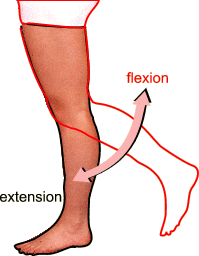 The goal of these exercises is to improve the ability of the knee to bend and straighten. Bending of the knee is known as flexion. Straightening of the knee is known as extension.
Meniscus tears can limit flexion and extension of the knee due to pain or blockage of movement in the joint.
For example, a portion of the torn meniscus can obstruct the normal mechanics of the knee joint.
Range of motion exercises can restore the normal mechanics of the knee joint and desensitize the knee to pain.
Full flexion and extension are important for optimal knee function. Restoring mobility of the knee is often the top priority whether or not you have surgery for a meniscus tear.
An example of a knee range of motion exercise:
A popular physical therapy exercise for meniscus tears is called knee extension. The exercise is performed by straightening the knee. These exercises can be performed in different positions with different amounts of resistance.
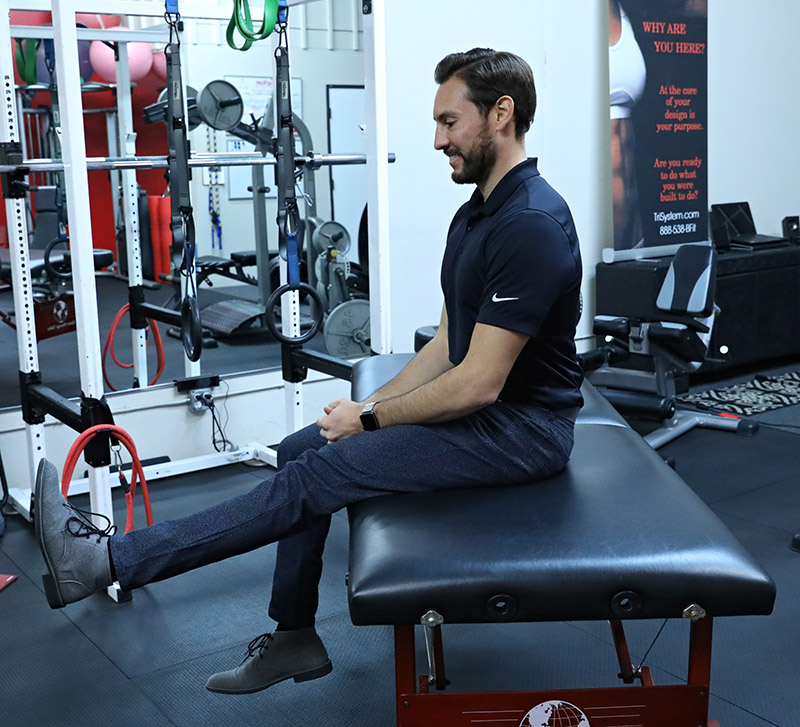
Starting Position
Sit at the edge of a chair, table or bed. Let the knee hang and relax to start.

Ending Position
Straighten the knee by contracting the quadriceps muscle. The quads are the muscles in the front of your thigh.
Try to fully straighten the knee within your tolerable limit. As the exercise becomes easier, a weight can be placed around the ankle.
It seems like a simple exercise, but it can be surprisingly difficult for someone who has a meniscus tear. A meniscus tear can limit the ability of the knee to fully straighten or bend.
It will not feel good to force the knee into flexion or extension too quickly; therefore, moving gently into these motions can help to gradually improve the mobility of the knee.
Most surgeons would prefer you to restore your knee motion prior to having surgery because you will have a better recovery after the surgery if you have more motion before the surgery.
Therefore, whether or not you have surgery, you want to restore as much knee motion as possible for proper knee function.
#2: Strength training exercises
Knee pain often causes muscles to be weak due to inhibition of the muscle and decreased use of the muscle. Perhaps, you have heard of the phrase, "Use it or lose it."
After a knee injury, you likely decreased your activity to allow the knee to recovery. It's normal to decrease your activity; however, the knee can get weak from the lack of use.
Your knee may feel limited right now because your muscles are weak. Therefore, you should focus on strengthening the muscles that support the knee.
A strength training program developed after an assessment with a physical therapist can provide you with the proper amount of repetitions, sets, weight, and progressions to recover from the meniscus tear to the best of your ability.
At first, your exercise program may start with easy exercises; however, the difficulty of these exercises will be increased as your knee adapts and becomes stronger.
An example of a strength training exercise:
Side lying leg raises are a great way to strengthen the muscles in the hip without aggravating the knee joint in people who have sensitive knees.
This exercise will strengthen a muscle on the side of the hip called the gluteus medius. The gluteus medius is important to maintain the knee in a good position while squatting, lunging, running, or walking.
If the gluteus medius is weak, it may not support the knee in a good position while you play sports or perform your normal daily activities.
If the position of the knee is not controlled, then there may be excessive strains on the knee joint which can delay healing from a meniscus tear.
Whenever you are recovering from an injury, you want to provide your body with a good environment for healing; therefore, you want to reduce excessive strain to the knee with strength training exercises.
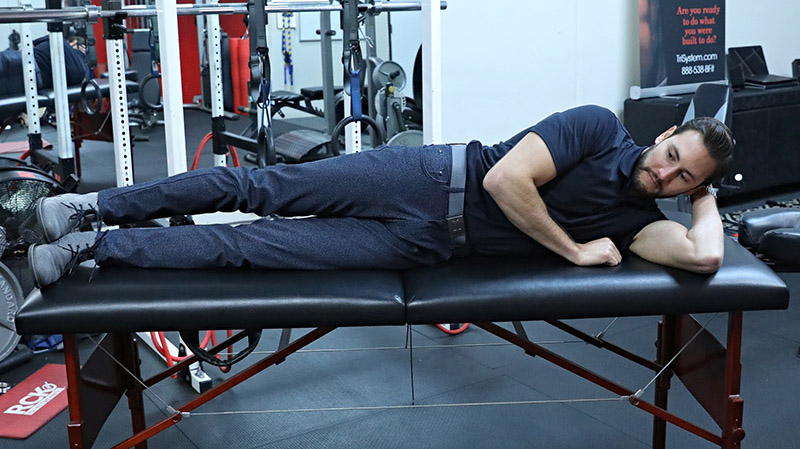
Starting position
Lie directly on your side. The feet should start together with or without a miniband around the ankles.
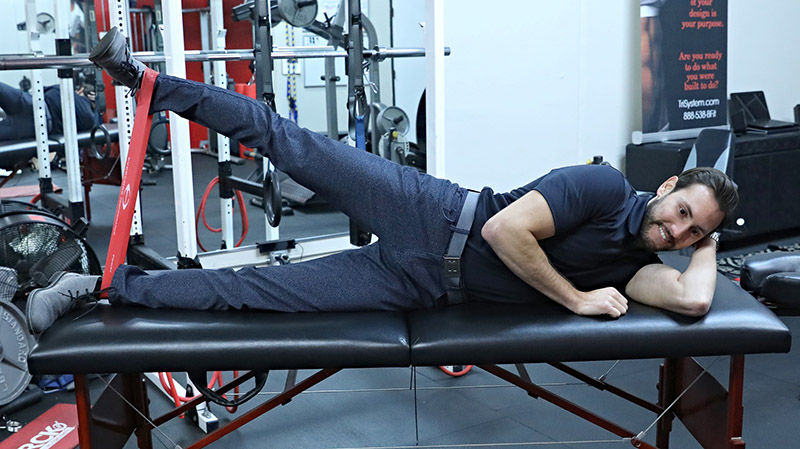
Ending position
Raise one leg back and up. Try not to rock the hips backward and let the leg move forward as it lifts into the air. Add the Evercore miniband around the ankles when the exercise becomes too easy without the band.
At first, try the exercise without resistance to focus on your technique. Once the exercise becomes easier, you can add an Evercore miniband around the thighs or ankles to increase the resistance.
Over time, the muscles around the knee will become stronger which helps to restore the pain-free function of your knee.
The gluteus muscle is one of the many important muscles for healthy knees. For example, it's essential to strengthen the muscles in the front of the thigh known as the quadriceps.
Those who have strong quadriceps before a knee surgery will have better outcomes after the knee surgery. The importance of strength training program cannot be emphasized enough.
If you want to increase your chance of avoiding a knee surgery for a meniscus tear, then you should be following a strength training program specifically designed to promote healing in the knee after a meniscus tear.
#3: Body control exercises
As mentioned before, a lack of knee control can lead to excessive strain on the knee joint. An excessive strain on the knee joint can lead to delayed recovery; therefore, you should be completing exercises to improve your body control.
The first step to body control is body awareness. Body awareness involves being conscious of the positions and movements of your body. When was the last time you thought about the position of your knees when squatting?
If you are able to squat right now, stand up out of your chair and sit back down on your chair. Did your knees cave inward? Did your knees move past your toes?
The movements we perform every day are automatic. We don't think about all our daily movements because that would take too much mental energy; therefore, our brain has hardwired these movement patterns into our body.
After an injury, these hardwired movement patterns become altered. When you are injured or experiencing pain, do you move the same?
Immediately after a meniscus tear, someone may be limping as they walk due to the pain and stiffness in their knee. As the pain and stiffness subsides, the brain and body remember these altered movement patterns.
Unfortunately, these altered movement patterns can become bad habits that need to be broken by retraining the brain and body with better movement patterns that promote normal function of the knee.
In addition, you may have learned these poor movement patterns from an early age. Fortunately, your brain and body can adapt very quickly when you provide it with the right stimulus.
The stimulus you need is an exercise-based rehab program to improve your control of body movements to decrease strain on the knee and promote healing from a meniscus tear.
Example of a body control exercise:
The lunge is a good exercise to practice control of your knee position. The goal of this exercise is to practice keeping the knee in alignment with the hip and foot.
In the early stages of meniscus tear healing, the knee may be sensitive to difficulty movement. The lunge can be a challenging exercise for people with knee injuries and many people have knee pain when the knee caves inward.
This exercise teaches you how to control the body position of the knee. The red Evercore power band is pulling the knee inward which forces you to maintain the knee in alignment with the hips and foot.

Starting position
Place the Evercore power band around the outside knee. The band will pull the knee inward.
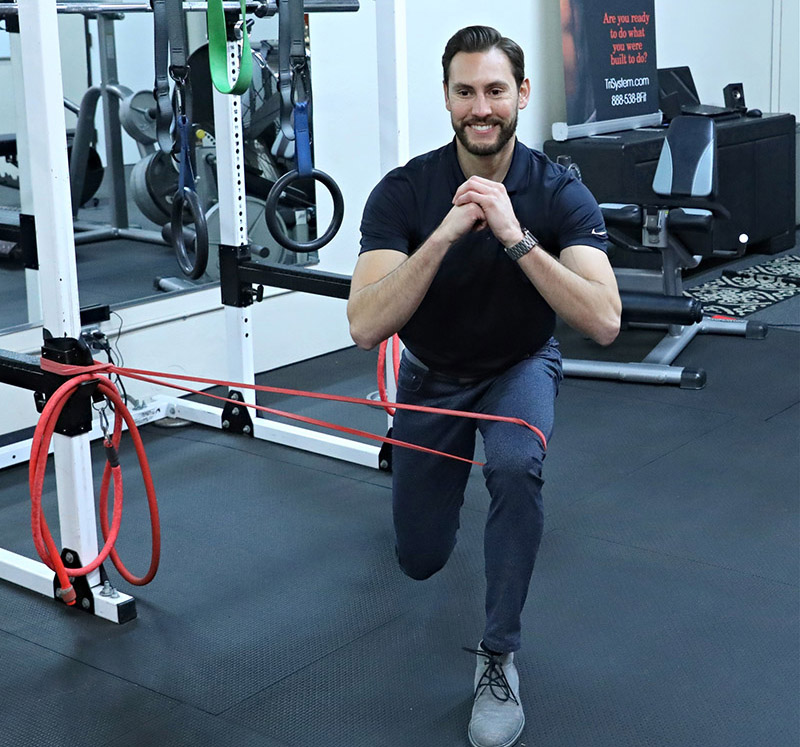
Ending position
Move your knee outward to position the knee, hip, and ankle in alignment. Then, perform lunges in this position.
The lunge may too difficult for you at this point in your recovery; however, the lunge can be modified based on your fitness level and goals. In addition, the difficulty of the lunge can be increased if it's too easy for you.
All these exercises have numerous modifications and progressions. They can be performed with a specific number of repetitions, sets, resistance, speed, tempo, and other variables specific to your goals.
Why do you need an exercise-based rehab program right now?
You may be holding back on your full participation in sports due to your knee injury. Your knee may have mostly recovered, but it's not 100%.
There may be a pain in the knee when squatting or discomfort when you run. You know the knee is not fully healthy and you may be looking for exercises or something that can help you recover.
It's best to take action now to start an exercise-based rehab program for the knee. There are two main benefits of an exercise-based rehab program:
- It will help to reduce your pain and increase your strength right now.
- It will provide long-term health to your knee to avoid advanced arthritis in the knees
Previous knee injuries have an impact on the long-term health of your knees. Those with previous meniscus tears and ACL tears have more arthritis and difficulties with their knees later in life than those who do not have these injuries.
Unfortunately, your knee injury occurred; however, the knee injury is in the past. You can't change the past, but you can create a new future.
If your knee still feels limited, then I recommend you take action to schedule an assessment with a physical therapist.
Watch this YouTube video to learn more details about meniscus tears:
How can you contact a physical therapist?
In most states in the United States, you can schedule a visit directly with a physical therapist without a referral from your primary care doctor.
However, due to insurance limitations, most of you will need to schedule a visit with your primary care doctor before seeing a physical therapist.
This option will allow your physical therapy plan to be covered by your insurance company; however, there are drawbacks by using your insurance company such as:
- A limited number of visits
- Potentially long wait times for appointments
In my opinion, a visit with a cash-based physical therapist is a better option because you can start an exercise-based rehab program right away without any restrictions from your insurance.
You can see a cash-based physical therapist whenever you want and for as long as you want. I recommend you search for a good, local physical therapist who can guide you with your recovery process.
If you don't know of good physical therapy, then you can send me an email to marc@evercorelife.com for additional guidance.
How Adam reduced knee pain